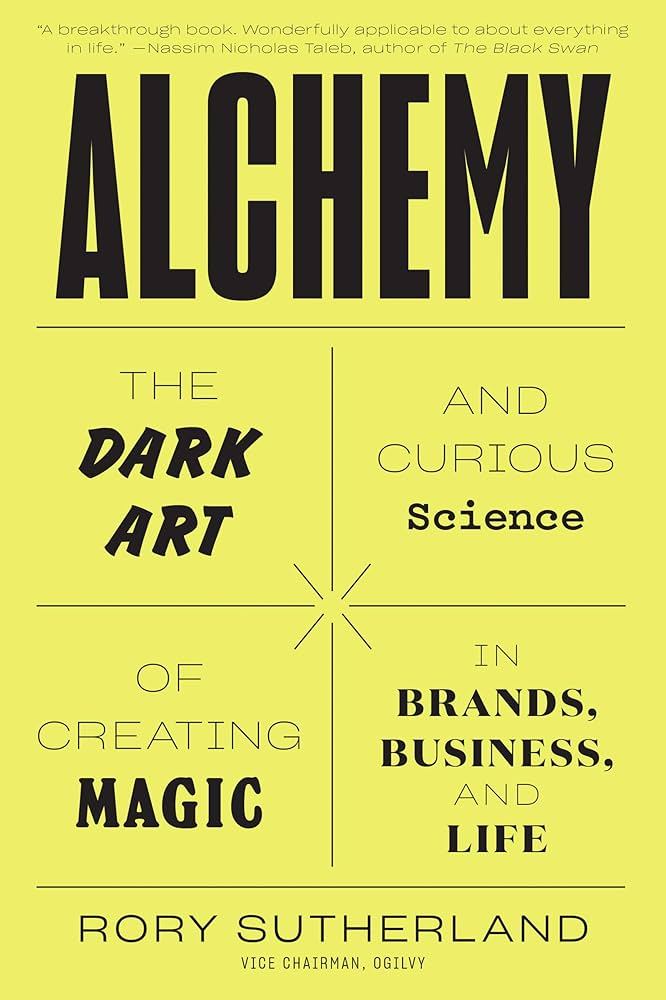
Alchemy
The opposite of a Good idea is another good idea.
Scarcity and Ubiquity can both be good things.
"You know it's good because everyone uses it." AND "You know it's good because only a few people are allowed to use it."
They are opposite of each other, but they both convey the same message of quality and make a similar impression.
- P.26
Context is everything
You might have entirely different political positions based on context.
"At the state level, I'm a republican, at the local level I'm a democrat. In my family I'm a socialist, and with my dog I'm a marxist."
-
The fatal issue is that logic gets you to the same place as all of your competitors. -p.34
-
"Test counterintuitive things, because no one else ever does"
Why we should ignore our GPS
Sometimes the "right" answer isn't always the __best__ answer.
The Broken Binoculars
"'The Trouble with market research is that people dont think what they feel, they don't say what they think, and they don't do what they say.' Peeople simply don't have introspective access into their emotions. -p.54.
Problems can be solved laterally not just literally.
A customer might say "the waiting window is too long", but solving that literally might be far too expensive. Therefore, is there a way to get 90% of the gain for 1% of the cost?Perhaps a text 30 minutes in advance of when the waiting will be done, in the case of a home repairman.
-p.56
1.11 Beware of Averages
Metrics, and especially averages, encourage you to focus on the middle of the market. But innovation happens at the extremes. You are more likely to come up with a good idea focusing on one outlier than on ten average users.
1.15 Same facts, different context
When you are buying mainstream items, it pays to cultivate mainstream tastes. But when you are buying something in scarce supply, it pays to be a little eccentric. -p.113
3.6 Creativity as a costly signalling
i.e., Signalling cost with creativity.
"All powerful messages must contain an element of absurdity, difficulty or extravagance - because rational behavior and talk, for all their strengths, convey no meaning. -p.183
5.6 Why the best is not always the least worst
Gerd Gigerenzer - "Defensive Decision Making"
We often don't make choices to maximize our good outcomes, but rather to reduce our potential catostrophic outcomes.
6.8 The map is not the territory, but the packaging is the product
"You see? I have just demonstrated that humans eat not just food, but words too" -p.297
6.13 The Ikea effect: why it doesn't pay to make things too easy
Betty crocker cake mixes were too easy and people werent buying them
When it was suspected that the ease was making women feel guilty, the used Benign Bullshit and included "just add 1 egg" to the instructions
Sales shot up
With Ikea, the Ingvar Komprad was convinced that if the owner of a piece of furniture helped to build it, the sense of value the piece had would increase
Takeaways
It pays to think differently, either for better or worse... Yes, you can score big, but you need to be careful and thoughtful about how to you about all this different, status-quo-challenging thinking by insulating yourself from some of the potential catastrophic outcomes. I've found that transparent, proactive communication helps immensely. Also, just thinking ahead with questions like "what might the concerns of others be if I were to pursue this?" Perhaps it's the cost and there are ways to mitigate that, or perhaps it's something else.
People really like to have big problems get solved with big solutions. I don't understand why this is the case because we all love a good david-v-goliath story, we all cheer for the underdog, and yet we think that million dollar problems need million dollar solutions. It's even STRANGER that we think this way, given that we hear these stories sometimes, love them, and still want the big fix for whatever our next problem is.
I spend a lot of time thinking about the question "how can I make it easy for others to see value?" but I wonder if I'm thinking about it wrong. Maybe I need to rethink that question.
The "defensive decision making" bit really struck me. How we hate being suckered even more than we love winning. We do things in order to reduce risks of the big negative consequences rather than investing in the moonshots.
Is there a way around this? some kind of 70% reliable delivery and 30% moonshots?
I think this book stuck out to you because you have a natural propensity for thinking this way anyway and it tickled your ego a bit. That's fine though. I think there's still a LOT to improve upon. I find that a lot of the time, the real struggle is getting others on board. It's almost like you have to do some of these ideas in secret.
Another piece that really stuck with me is how logic is obvious, and therefore easy to reproduce. If you are only making logical decisions, what's to stop your competitors from doing the same thing and eating your lunch?